What Grandma's China Is Really Worth
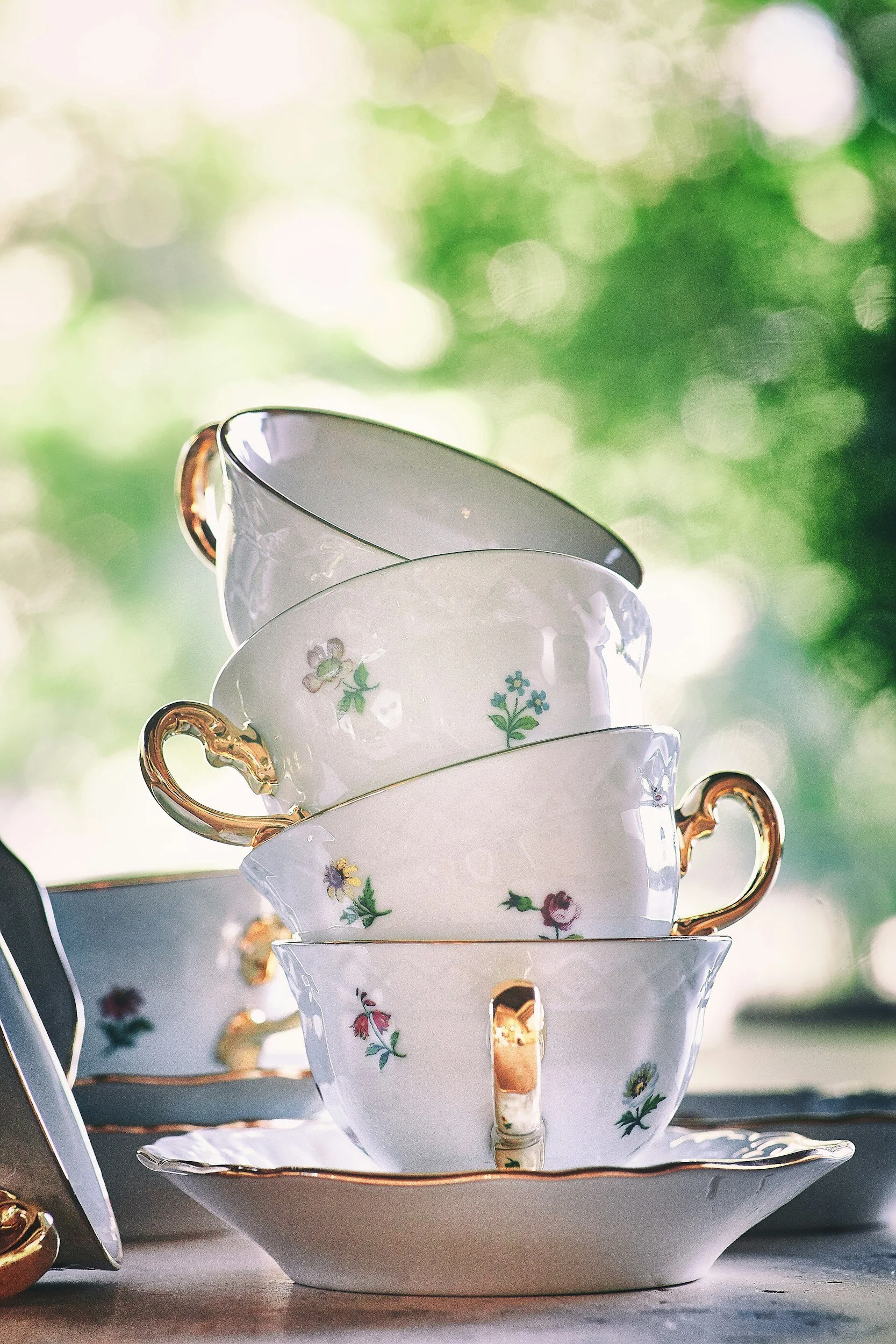
Every so often we encounter it in a client's home: a full set of china, carefully wrapped in tissue paper, tucked into a hutch or stacked in a cabinet that hasn't been opened in years. Maybe it was your grandmother's. Maybe it came with the house sale of a parent's estate. Maybe someone gave it to you because they didn't know what else to do with it either.
You don't hate it. You just… don't use it.
China is one version of this, but it's rarely the only one. A piece of furniture that doesn't fit the house. A collection someone else loved. A box of things from a parent's home that never quite got sorted. The object changes but the feeling is almost always the same. Too meaningful to let go of easily yet too present to ignore.
And honestly? We get it. Even as professional organizers, we're not immune. Many of us own beautiful formal pieces we envisioned using someday, only to find that real life rarely calls for them the way we imagined. The occasion never quite arrives. The cabinet stays closed.
And yet, getting rid of china feels different than donating a stack of old paperbacks. There's history in those plates. There's a story. There are holidays and Sunday dinners and people who are no longer here. So it sits taking up space, carrying weight, waiting for a solution that never quite arrives.
At Signature Organizing, we help clients solve this one dish at a time. And the good news? There are more options than you think.
Get Honest
Before deciding what to do with inherited china, it helps to ask yourself a few straightforward questions:
Have you used it in the last five years?
Do you have the space to store it properly?
Would you genuinely host a formal dinner or host a tea party someday with your kids or grandkids?
There's no wrong answer. But your honest answer should guide the rest of your decisions. Some people do use their china, and for them, the goal is better storage. Others keep it for purely sentimental reasons and need permission to let go. Most fall somewhere in between.
Store It
If you want to hold onto your china even for occasional use storage matters. Improperly stored china chips, cracks, and fades. A few principles:
Use proper dividers. Felt or foam plate separators prevent scratches between stacked pieces. These are inexpensive and widely available.
Store cups upright, not stacked. Handles are fragile. Hanging cup hooks inside a cabinet are a smart solution.
Climate matters. Avoid garages, attics, or anywhere with dramatic temperature swings. Fine china is sensitive to humidity and heat.
Label your boxes. If your china lives in storage, clear labeling means you'll actually find it and use it when the occasion comes.
A well-organized hutch or dedicated cabinet can make your china feel intentional rather than forgotten.
Display It
China doesn't have to be tucked away to be honored. A few display ideas that actually work in modern homes:
Open shelving in a dining room or kitchen can showcase a few statement pieces without giving over an entire cabinet.
A single large platter or serving bowl used as a decorative centerpiece on a buffet or sideboard keeps the heirloom visible without requiring storage for the full set.
Plate stands allow you to display individual pieces on a shelf, bookcase, or mantel treating them like the art they often are.
You don't have to display all of it. Choosing one or two meaningful pieces to live in your home, while finding another path for the rest, is a completely valid approach.
Pass It On to Family
If the china has sentimental value, the best outcome is often finding a family member who will genuinely use and appreciate it. But this requires some intention.
Don't assume. Ask before transferring. Adult children or nieces and nephews may feel obligated to take it even if they don't want it which just moves the problem one generation forward.
Offer pieces, not the whole set. A granddaughter who loves the teacups doesn't need to take the entire 12-place setting. Splitting a set among family members who each want a portion is a perfectly good solution.
Document the story. If you do pass china along, take a moment to write down what you know about it - who it belonged to, when it was used, why it mattered. Even a handwritten note tucked inside the box turns dishes into something more.
Sell It
This is where the title of this post really comes into focus: what is grandma's china actually worth? Probably less than you think. The resale market for formal china has softened considerably over the last two decades. A full 12-place setting from a well-known brand like Lenox, Wedgwood, or Noritake might fetch $50–$200 at an estate sale sometimes less.
Individual pieces on eBay can sit for months with no takers. Replacements, Ltd., which specializes in discontinued patterns, buys china at a fraction of what they sell it for. That doesn't mean it's worthless. Some patterns do hold value, and it's worth a quick search of your pattern name before you decide.
For most people, the time required to photograph, list, pack, and ship china doesn't justify the return. We rarely push clients toward resale for this reason. Donating and moving on is often the more practical and less frustrating path.
Donate It
If selling isn't worth your time, donation is a meaningful option. Organizations that may accept china include:
Habitat for Humanity ReStores
Local thrift stores (Goodwill, Value Village)
Theater and film prop departments: community theaters often want mismatched formal dishes
Women's shelters and transitional housing programs: organizations helping people set up new households welcome kitchenware
So Why Do We Keep It?
Here's the honest question underneath all of this: if you don't use it, don't love it, and it won't sell for much…why is it still in your home?
Usually it's guilt. Getting rid of china (or silver, or a piece of furniture, or any inherited object) can feel like a verdict on the person who owned it. Like you're saying their things didn't matter, or that you didn't love them enough to keep what they left behind. That feeling is real and worth acknowledging but it's also worth examining. An object sitting in a cabinet you never open isn't a tribute. It's just storage.
If you genuinely don't know the story behind the china like who it belonged to and why it mattered that changes things too. Sentimental value requires sentiment. If it arrived in your home without context, you're not obligated to manufacture an attachment that isn't there.
We Might Use It Someday
Sometimes clients hold onto china with a vague future vision like tea parties, holiday dinners, a someday that keeps not arriving. It's worth asking honestly, does that future actually match how you live?
If your household runs on casual dinners and everyday dishes, a 48-piece formal set probably isn't going to come down off the shelf for a Tuesday in November. And that's fine it just means the set isn't for you. If there's a real and specific occasion you'd use it for, keep what you need for that and let the rest go. You don't need 12 place settings to actually use something beautiful.
One Dish at a Time
The hardest part of dealing with inherited china isn't logistical it's emotional. These pieces carry the weight of people we've loved and kitchens we no longer have access to. Letting go of any part of a set can feel like letting go of something more.
At Signature Organizing, we sit with clients in that feeling. We don't rush past it. But we also gently help people see that an object gathering dust in a cabinet isn't the same as honoring a memory and that sometimes, the most respectful thing you can do with something beautiful is let it be used again.
Whether you store it, display it, sell it, share it, or donate it: there's a right answer for your home. We'll help you find it.

Jessica is the founder of Signature Organizing, a Professional Home Organizing Business in Washington (servicing the greater Eastside and Seattle area). She loves transforming chaos into functional spaces and is known for bringing creative solutions to improve the quality of life for her clients. She shares her tips and tricks on Instagram @signatureorganizing